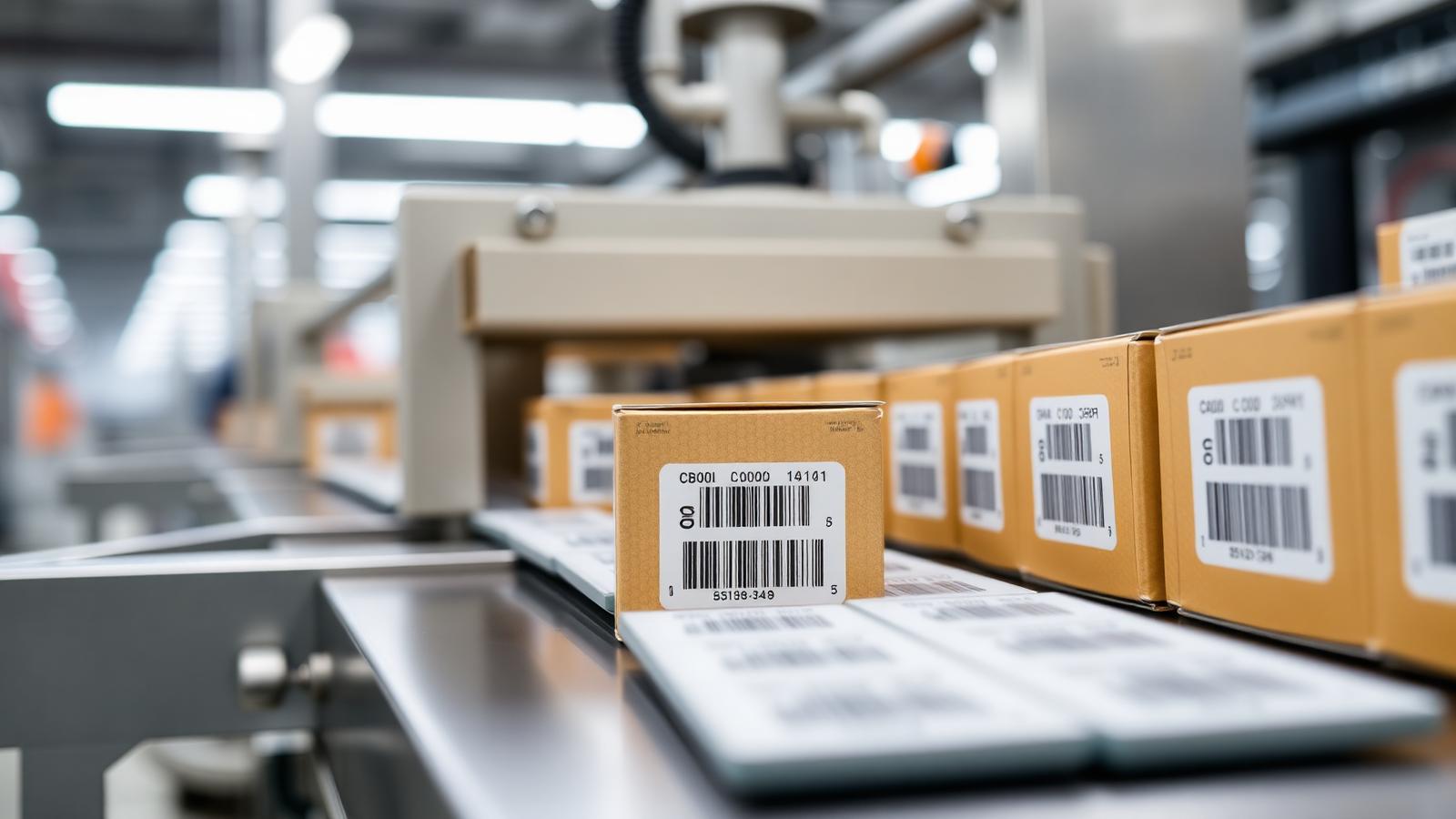
The Drug Supply Chain Security Act (DSCSA) is usually discussed as a data problem: EPCIS files, trading partner connections, exception handling. On the packaging floor it is also a very physical problem. Every serialized package has to carry a barcode that scans correctly the first time, at every node, months or years after it was printed.
This post covers what the law requires on the label itself, why the 2D DataMatrix became the standard carrier, and where labels fail in practice.
What Is the DSCSA Product Identifier?
DSCSA requires a product identifier on each package and each homogeneous case of a prescription drug in the U.S. supply chain. The product identifier is made up of four data elements:
| Data element | What it is | Notes |
|---|---|---|
| National Drug Code (NDC) | FDA-assigned code identifying the drug | Today a 10-digit code in several segment formats, moving to a uniform 12-digit format in 2033 |
| Serial number | A unique number for that individual package | Up to 20 characters, unique within the NDC |
| Lot number | The production batch identifier | Ties the package back to manufacturing records |
| Expiration date | The package expiration | Encoded and printed in human-readable form |
That combination is why serialized pharma labels are usually more crowded than they look. You are printing a graphic symbol plus four printed fields, in a fixed footprint, without crowding the existing regulatory copy.
Why 2D DataMatrix Instead of a Linear Barcode?
Linear barcodes encode data horizontally, so more characters means a wider symbol. A serialized product identifier can run past 40 characters once the GS1 application identifiers, NDC, serial number, lot, and expiration date are combined. A linear code carrying that payload would not fit on a unit carton, let alone a vial.
A GS1 DataMatrix solves three problems at once:
- Density. It encodes the full payload in a small square, often under half an inch, which fits on small cartons and vials.
- Error correction. Reed-Solomon error correction lets a scanner recover the data even when part of the symbol is scuffed or obscured. This is the single biggest practical advantage in distribution.
- Structure. GS1 application identifiers label each field inside the code (product identifier, serial, lot, expiration), so any compliant scanner parses the same payload the same way without a custom decode map.
The trade-off: DataMatrix is far less forgiving about print quality and contrast than a wide linear barcode. A code that is 20% too dark, printed on a rough facestock, or placed too close to a fold can read fine on the line and fail three nodes later.
Where Serialized Labels Fail in the Real Supply Chain
A serialized label has to survive filling, cartoning, palletizing, transit, one or more distribution centers, and often refrigeration. Below are the failure modes we see most often, and what usually causes them.
| Failure | What it looks like | Usual root cause |
|---|---|---|
| Low contrast | Scanner hunts, grades drop, some units fail | Darkness set too low, wrong ribbon chemistry for the facestock, or a worn printhead |
| Over-print / bleed | Cells merge, code becomes unreadable | Darkness set too high, or excessive head pressure on the printhead |
| Element voids | Thin white lines through the code | Debris or burned-out printhead elements, see printhead care |
| Quiet-zone violation | Reads on a fixed scanner, fails on handhelds | Code placed too close to a die-cut edge, fold, or adjacent artwork |
| Distortion on curved surfaces | Reads at one angle only | Symbol placed across the curve of a small vial or ampoule instead of along the flattest area |
| Label lift and edge curl | Corner peels, code partially obscured | Adhesive not matched to the substrate or to cold-chain conditions |
| Print fade or abrasion | Code fades after transit | Direct thermal used where thermal transfer with a resin ribbon was needed |
| Adhesive residue on scanning windows | Progressive read failures across a line | Adhesive migration from a soft, general-purpose adhesive |
Practical Takeaways for Packaging and Compliance Teams
- Verify, do not assume. Grade printed codes with a verifier at the start of each run and after any printer service, not only at validation. A scanner tells you whether it read. A verifier tells you how much margin you have left.
- Protect the quiet zone in artwork, not on the line. Build the clear area into the die line and the artwork template so operators cannot squeeze it out during a layout change.
- Match the print method to the life of the package. Direct thermal is fine for short-life internal labels. Serialized packages that face light, heat, or handling should be thermal transfer with an appropriate ribbon, or pre-printed with a durable process.
- Test the label where the package lives. Freeze it, thaw it, wipe it, abrade it, and rescan. Cold-chain condensation defeats more adhesives than cold temperature does.
- Control the facestock, not just the printer. Rough or uncoated stock scatters the edges of DataMatrix cells and eats your grade margin before the printer is even involved.
- Document the construction. Facestock, adhesive, liner, ribbon, and printer settings together make a validated label. Record all five so a reorder does not silently change one of them.
How Country Innovation & Supply Helps
CIS is a labeling and materials partner, not a regulatory consultant. We do not interpret the law for you. What we do is make sure the physical label carries your serialized data reliably:
- Pre-printed serialization and labeling solutions that support DSCSA track-and-trace requirements, so your line applies a verified label instead of fighting print quality.
- Adhesive, face stock, and print method matching for pharmaceutical applications, including cold chain, small-diameter vials, and cartons that see rough handling.
- Durable, scannable label construction chosen for the conditions your packages actually see between the line and the pharmacy shelf.
If you are reviewing a serialized label that is failing scans, or specifying one for a new presentation, our team can look at the construction with you.
Talk to the CIS team about your labeling requirements or explore industrial label capabilities._Talk to a real person in minutes, no bots, no delays._
Related References
- NDC-12 Is Coming in 2033, what the uniform 12-digit NDC means for artwork
- Label Construction for Pharmaceutical Compliance, face stock, adhesive, and print method
- Pre-Printed Serialization and Track-and-Trace
- Thermal Labels Resource Center, thermal transfer vs direct thermal
- Industrial Labels, custom label capabilities