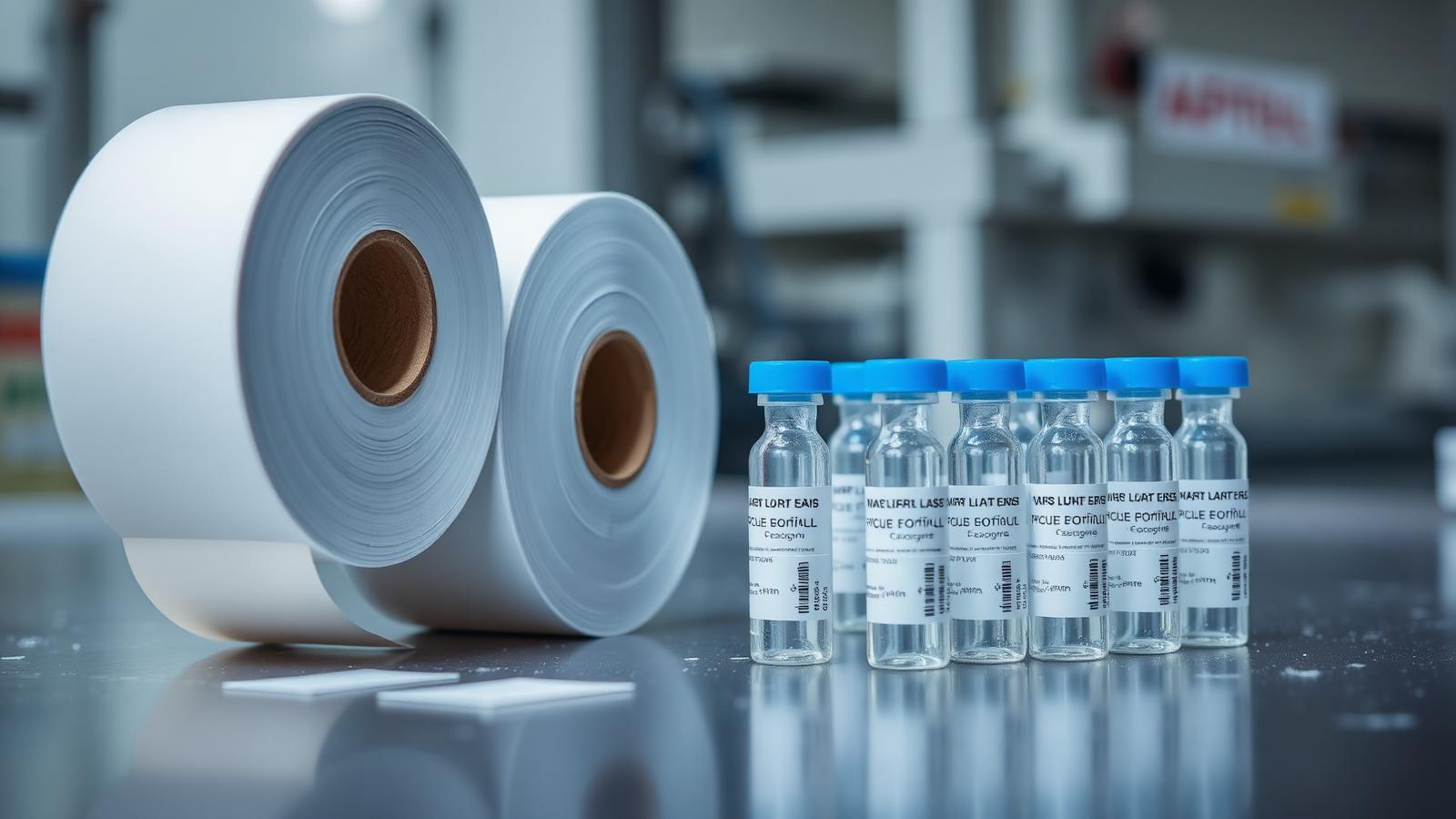
A serialized label is only compliant if it can still be read. That sounds obvious, and it is exactly where audits and customer complaints land: a code that verified perfectly at the packaging line but will not scan at a distribution center or a pharmacy.
Three decisions determine whether that happens: the face stock you print on, the adhesive holding the label to the container, and the print method that puts the image down. This post walks through each, plus the failure modes that show up when one of them is wrong.
Why Does Label Construction Matter for DSCSA Compliance?
The DSCSA product identifier (NDC, serial number, lot, and expiration date) is carried in a small, dense 2D DataMatrix. Dense symbols have far less tolerance than a wide linear barcode. A modest loss of contrast, a slightly rough surface, a curled corner, or light abrasion can take a code from a comfortable grade to a failed read.
Construction is what buys back that tolerance. It is cheaper to specify the right material once than to investigate scan failures across a released lot.
Face Stock: What Are You Printing On?
| Face stock | Best for | Watch out for |
|---|---|---|
| Coated paper (semi-gloss) | Room-temperature cartons, short distribution paths, cost-sensitive high volume | Absorbs moisture, tears, and loses contrast if the surface is scuffed |
| White polypropylene (BOPP) | Vials, ampoules, squeezable containers, humid or wet environments | Needs a compatible print process, can shrink slightly under heat |
| Polyester (PET) | Autoclave, solvent wipe-down, long service life, harsh handling | Higher cost, stiffer and less conformable on small diameters |
| Polyethylene | Squeeze bottles and flexible containers where the label must move with the pack | Lower dimensional stability, print method must accommodate stretch |
| Cold-chain / freezer grade constructions | Refrigerated and frozen product, condensation-prone surfaces | Application temperature is the real constraint, not just service temperature |
Adhesive: Where Most Complaints Actually Start
Adhesive selection is where "the label failed" usually begins. Four factors decide it:
- Substrate energy. Glass and coated cartons behave nothing like a low-surface-energy plastic bottle. A general-purpose permanent adhesive that works on cartonboard can peel off HDPE.
- Application temperature. Many adhesives will not flow and bond below a minimum application temperature. Applying a standard adhesive to a chilled vial is the classic cause of edge lift.
- Service conditions. Cold chain, condensation, freeze-thaw cycling, humidity, and solvent wipe-down each pull differently on the bond.
- Container geometry. Small-diameter vials and ampoules fight the label's memory. A stiff facestock plus a slow-wetting adhesive equals a lifted corner, often right over the barcode.
Practical adhesive guidance for pharma:
- Cold chain and freezer: use a cold-temperature or all-temperature adhesive rated for the application temperature, not just the storage temperature.
- Small diameter (under roughly one inch): favor a conformable facestock with an aggressive, fast-wetting adhesive.
- Glass vials: confirm compatibility with any cleaning or wipe-down step, and verify no residue is left if the label must be removed.
- Plastic containers: identify the resin. Low-surface-energy plastics need an adhesive formulated for them.
- Removable or repositionable requirements: state them explicitly. "Permanent" and "no residue" are different requirements and often need different constructions.
Print Method: Durability of the Image
| Method | How it images | Good fit | Limitation |
|---|---|---|---|
| Direct thermal | Heat-sensitive facestock, no ribbon | Short-life internal labels, in-plant work in process | Image fades with heat, light, and abrasion, so it is a poor fit for released packages traveling through distribution |
| Thermal transfer, wax ribbon | Ribbon melted onto paper | Cartons, low-abrasion room-temperature use | Smears under abrasion or solvents |
| Thermal transfer, wax-resin | Blended ribbon | Coated paper and some synthetics, general durability | Needs facestock matching to avoid smearing |
| Thermal transfer, resin | Resin ribbon on synthetics | Vials, cold chain, solvent exposure, long-life labels | Requires synthetic facestock and correct heat settings |
| Flexographic pre-print | Plate-based press printing | High-volume fixed artwork with excellent registration and color | Plate changes cost time, so it favors stable artwork |
| Digital pre-print | Inkjet or electrophotographic press | Shorter runs, multiple presentations, variable data | Ink and facestock combination must be qualified for the environment |
Common Failure Points and How to Prevent Them
| Failure | What you see | Prevention |
|---|---|---|
| Label lift / edge curl | Corner peels, often over the barcode | Match adhesive to application temperature and substrate, use a conformable facestock on small diameters |
| Print fade | Code washes out after transit or light exposure | Move off direct thermal, or step up to wax-resin or resin on a synthetic facestock |
| Adhesive residue | Sticky film left on glass or on line equipment | Specify a construction qualified for the substrate and any wipe-down step |
| Poor contrast | Verifier grade drops, scanners hunt | Use a smooth, high-opacity white facestock, correct ribbon chemistry, and the lowest darkness that grades well |
| Smearing | Code blurs under abrasion | Match ribbon chemistry to facestock, then confirm with an abrasion test |
| Moisture failure | Paper label wrinkles or delaminates | Use a synthetic facestock in humid, refrigerated, or wash-down conditions |
| Distortion on curves | Code reads from one angle only | Place the symbol on the flattest available area and confirm module size at that curvature |
Practical Takeaways for Operations and Packaging Teams
- Qualify the construction as a system. Facestock, adhesive, liner, ribbon, and printer settings are one specification. Change one and you have a new label.
- Test at application conditions, not room temperature. If vials are labeled cold, test cold.
- Run a real abuse sequence. Freeze, thaw, wipe, abrade, then verify the barcode. Grade before and after.
- Verify, do not just scan. A verifier tells you how much margin remains, which is what predicts field failures.
- Lock the specification against reorders. Record exact material part numbers so a substitution does not quietly enter a validated label.
- Involve materials expertise early. Adhesive and facestock changes after artwork approval are the expensive ones.
How Country Innovation & Supply Helps
CIS is a practical labeling and materials partner. We do not provide regulatory interpretation. What we bring:
- Expertise matching adhesives, face stocks, and print methods to pharmaceutical applications, including cold chain, glass vials, small-diameter containers, and solvent exposure.
- Durable, scannable label selection for the conditions your packages actually see between the line and the pharmacy.
- Pre-printed serialization and labeling solutions that support DSCSA track-and-trace requirements.
Send us the container, the environment, and the print process you are working with, and we will talk through the construction.
Discuss your label construction with the CIS team or review industrial label capabilities._Talk to a real person in minutes, no bots, no delays._
Related References
- What DSCSA Actually Requires on the Label
- NDC-12 Is Coming in 2033
- Pre-Printed Serialization and Track-and-Trace
- Thermal Labels Resource Center, thermal transfer vs direct thermal
- Stock Thermal Transfer Ribbons, wax, wax-resin, and resin by facestock