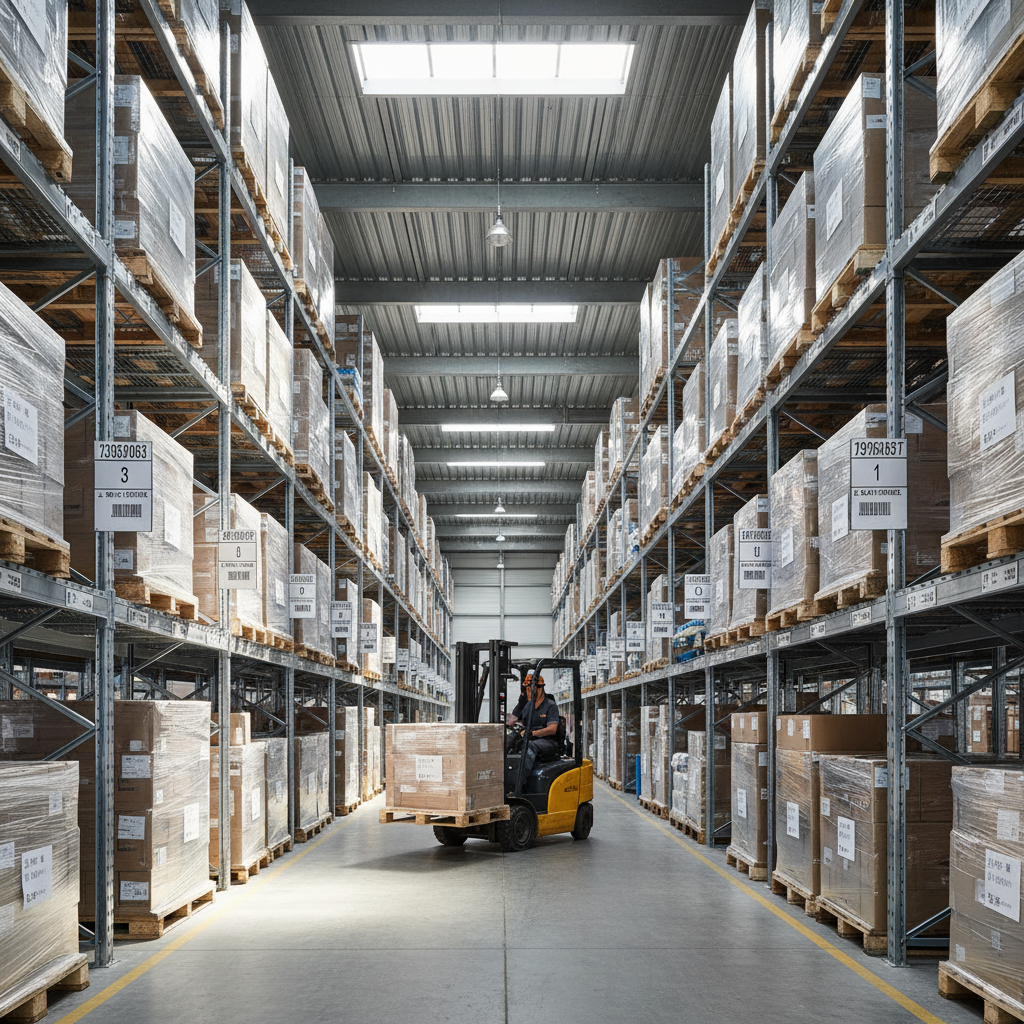
Retro-reflective warehouse labels are built to be scanned from a distance, so a forklift driver or picker on the floor can read a location barcode on an upper rack beam without going up to it. With a long-range scanner, CIS retro-reflective rack labels offer about 4 to 20+ feet scan distance (typical for a long-range scanner). The actual read range in your building depends on your scanner, the barcode size, mounting height, angle, and lighting, so the best way to plan is to start from the scanner you already use.
How Retro-Reflective Labels Work
A standard paper or matte film label scatters light in every direction. Only a small share of the scanner's light makes it back to the scanner window, which is fine at arm's length but weak at a distance.
Retro-reflective material is different. When a long-range scanner aims at the label, much more of its light returns to the scanner, so the black bars of the barcode stand out sharply against a bright background. That extra contrast is what lets the scanner decode the label from farther away.
CIS prints retro-reflective rack labels on retro-reflective polyester face stock with thermal transfer printing, so each label carries your own location data. As the CIS catalog puts it, "Retro-reflective label material allows for scanning from longer distances and is perfect for high level racks that need to be scanned from the ground level."
What Affects Read Range
No label has a single fixed scan distance. Read range is the result of the whole setup working together. These are the factors that matter most.
Scanner type
This is the biggest factor. Standard handheld imagers are designed for close work at the pick face. Long-range and extended-range scanners are built to read barcodes across an aisle or up a rack, and retro-reflective labels are designed to be read with them. If your team only has standard imagers, a retro-reflective label alone will not give you long-range reads. Check your scanner's published spec sheet for its rated range on reflective labels, and tell your label supplier the model.
Label and barcode size
Bigger barcodes with wider bars are easier to read from far away. Small, dense barcodes need the scanner to be closer. Long-range labels usually pair the retro-reflective face stock with an oversized barcode. The right size depends on your scanner and the distance from the operator to the beam, so size the label to your setup rather than picking one off a chart.
Mounting height
The higher the label, the longer the distance from the operator to the barcode and the steeper the angle. Labels on the first and second levels may be fine as standard labels. Upper levels in high-bay racking are where retro-reflective labels earn their place.
Angle
Scanners read best when they face the barcode fairly directly. When an operator on the floor aims up at a top beam, the steep angle can make reads harder. Wrap-around labels help here. In the CIS catalog's words, "Wrap-around labels cover the front and bottom of the beam to make scanning from the ground, and in tight areas, easier." The bottom face gives the scanner a flatter target from below.
Lighting
Glare from skylights, high-bay fixtures, or dock doors can wash out a barcode, and very dim upper levels give the scanner less to work with. Retro-reflective material helps because it sends the scanner's own light back to it, but it is still worth testing reads under your real lighting, at different times of day if you have daylight in the building.
Label condition and placement
Dirt, scuffs, and labels mounted on dented or uneven beams all cut into read range. Clean, flat mounting surfaces and a consistent placement on every beam make long-range scanning far more reliable.
When to Use Retro-Reflective Labels
Retro-reflective labels make sense when:
* You run high-bay racking and operators scan upper locations from the floor or from a forklift.
* Your team already uses long-range scanners, or plans to.
* Reach trucks and forklift drivers need to confirm locations without raising the forks or leaving the seat.
* You want to cut the time spent getting close to a label just to scan it.
They are usually not needed when all scanning happens close to the label at the pick face, such as low shelving and carton flow racks.
If your team does not have long-range scanners, there is another option. Multi-level and totem rack labels put the data for several locations on one label mounted at a reachable height. The CIS catalog describes them as "Great for applications without a long range scanner."
How to Choose the Right Long-Range Label
Use this checklist before you order:
- Start with your scanner. Write down the make and model your operators use and look up its rated range on its spec sheet.
- Measure your racks. Note the number of levels and the beam heights, and where operators stand or sit when they scan.
- Decide which levels need retro-reflective. Many sites use standard labels on lower levels and retro-reflective labels on upper levels.
- Pick the format. Choose flat beam labels, wrap-around labels for upper beams, or totem labels if long-range scanning is not in the plan.
- Check your location data before print. A long-range label with the wrong location code is just as wrong as a short-range one, and fixing it means going back up the rack. Make sure your location list has no duplicates or format errors before it goes to print.
- Test a sample. Scan a sample label from your real operator positions, with your real scanners and lighting, before you label the whole building.
CIS supplies warehouse rack labels nationwide, including retro-reflective, multi-level, totem, and standard location labels. We can help you match the label to your scanner and racking, and check your location data before it goes to print.
FAQ
What is a retro-reflective rack label?It is a location label printed on retro-reflective material that bounces a scanner's light back toward the scanner. That makes the barcode easier to read from a distance, such as from the floor or a forklift.
How far can retro-reflective rack labels be scanned?CIS retro-reflective labels offer about 4 to 20+ feet scan distance (typical for a long-range scanner). Your actual read range depends on your scanner, barcode size, mounting height, angle, and lighting, so tell us your scanner model.
Do I need a long-range scanner?Yes. Retro-reflective labels are designed to be read with a long-range scanner. If your team uses standard imagers, totem or multi-level labels that bring upper locations to a reachable height are usually the better fit.
When should I use standard rack labels instead?Use standard labels when scanning happens at the pick face, close to the label. Retro-reflective labels are for upper levels scanned from a distance.
How are upper-level labels placed so they scan from the floor?Wrap-around labels cover the front and bottom of the beam, which makes scanning from the ground, and in tight areas, easier.
What do you need for a quote?Your rack heights and levels, scanner model, location count and location file, a few bay photos, and your go-live date.
Get the Right Labels for Your Racks
Tell us your rack heights and scanner model, and we will spec retro-reflective labels to match. See our warehouse labeling solutions or call 770-561-5285 for a quote.