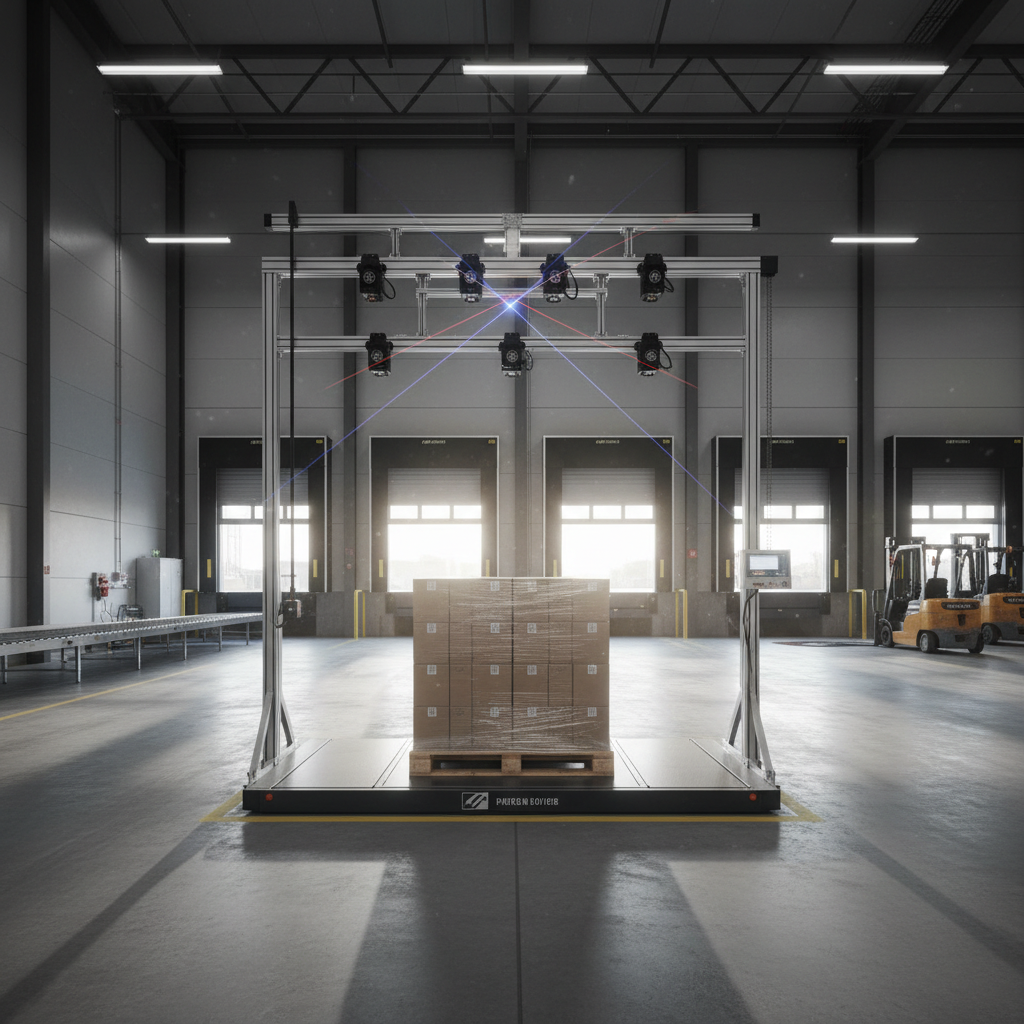
Take a quick walk down your shipping dock right before afternoon carrier pickups. You will likely see solid, well-built pallets ready to roll onto trailers. Look closer at the edges, though. Do you see carton corners hanging an inch over the deck boards? Are the middle tiers bulging out because cartons were overpacked or crushed under top loads? Are loose folds of stretch wrap billowing out at the corners? To the naked eye, those details seem minor. To carrier dimensioners, they represent billable cubic space that can silently push your freight into a higher cost bracket.
With freight classification increasingly determined by density, packaging engineering is no longer just about preventing transit damage. It is now a front-line lever for freight cost control.
The Strict Math of Outermost Dimensions
Modern freight terminals do not guess pallet dimensions, and they rarely rely on the nominal measurements written on a bill of lading. Automated overhead dimensioning systems scan pallets as forklifts drive beneath them. These scanners cast infrared light or lasers across the entire load to calculate length, width, and height.
Crucially, these systems measure the outermost points. If a pallet base measures 48 by 40 inches, but boxes hang over the edges by two inches on each side, the carrier bills the pallet as 52 by 44 inches.
That small spread expands your calculated cubic volume considerably. Because density is defined as weight divided by total cubic volume, an inflated cube lowers your pounds per cubic foot. In density-based freight pricing, lower density almost always results in a higher freight class, triggering unexpected reclassification charges and rate adjustments after pickup. Whether you are shipping LTL or moving cargo by air, paying for dead air around your skid eats directly into operating margins.
The Structural Penalty of Pallet Overhang
Beyond dimensional charges, carton overhang creates a direct mechanical problem. Corrugated containers derive the vast majority of their stacking strength from their vertical corners. When a carton rests squarely over another carton and sits fully on the wooden pallet deck, that corner strength remains intact.
When a box hangs over the edge of a pallet by even an inch, it loses a massive portion of its load-bearing capacity. The bottom edge is unsupported, transferring weight directly onto the carton sidewalls. Sidewalls buckle under vibration and vertical compression during transit.
Once bottom cartons buckle, two things happen:
- The load begins to lean, increasing the outermost footprint even further.
- The interior contents absorb transit shocks they were never engineered to take, leading to customer damage claims.
What began as an attempt to fit one more layer of product on a skid ends up causing freight reclasses, product returns, and replacement freight costs.
Dialing In Your Packaging to Protect Your Profile
Keeping a pallet profile square and compact requires alignment between the packaging materials you buy and how your dock team applies them. Here are three practical areas where packaging leads can make immediate improvements:
Match Carton Rigidity to Stack Height
Carton bulge is often an internal pressure problem. Overfilling boxes forces the walls outward, while underfilling allows top weight to crush the carton downward and bow the sides outward. Review your box strength ratings and void fill strategies. Using corrugated containers with appropriate crush resistance helps the sidewalls remain straight under static and dynamic warehouse loads.
Standardize Stretch Wrap Containment Force
Hand-wrapping pallets without proper technique or consistent tension often results in loose containment. The load shifts during transit, widening the overall profile. Switching to high-performance machine stretch film or training packers on proper pre-stretch hand application locks layers together tightly. The goal is true containment force, drawing the load inward without crushing the corners.
Use Edge Protectors to Define the Perimeter
Solid fiberboard corner boards, also called edge protectors, do double duty on a shipping dock. They distribute vertical strapping tension evenly across the entire stack, preventing strapping from biting into top cartons. Simultaneously, they create rigid, 90-degree vertical corners that keep the footprint square from bottom board to top cap, preventing automated scanners from flagging rogue overhang.
Bridging the Gap Between Engineering and the Dock
Packaging engineers often design optimal pallet patterns in software environments, assuming perfect cartons and flawless alignment. The reality on a busy distribution floor is that pickers and packers move fast. If carton sizes are awkward, workers will turn boxes sideways or allow overhang just to make everything fit on a single pallet tier.
Audit your finished pallets regularly. Measure the pallet after it is wrapped and tagged, not before. When you see consistent overhang or bulging, look back upstream. Does the packing station have the right carton sizes available? Are workers using void fill correctly? Is the stretch wrap gauge heavy enough to hold the product mass during transit?
Equipping your floor with dependable, high-quality Packaging Materials makes it far easier for dock crews to build clean, compliant pallets every time. At Country Innovation & Supply, we keep essential packaging supplies in stock across our U.S. facilities. When you need advice on matching stretch wrap gauge, strapping, or carton protection to your specific dock workflow, you can call us and speak with an experienced specialist who understands industrial packaging inside and out.
Keep Your Cube Honest
Every inch of air your pallet claims on a trailer or cargo bay is space you pay for. By tightening up pack tolerances, securing loads with the right materials, and eliminating pallet overhang, you protect both your products and your freight budget.
Did you know? The standard 48x40-inch pallet footprint originated largely to maximize the interior width of standard U.S. rail boxcars and truck trailers, leaving just enough clearance for side-by-side loading without wasted floor space. When cartons hang off even slightly, that engineered efficiency disappears completely.