Continuous improvement leaders understand that real cost reduction rarely comes from telling warehouse associates to move faster. When operations teams push for pure speed, errors rise, turnover spikes, and safety risks climb. The standard lean approach focuses on removing the work that should not exist in the first place: eliminating wasted motion, waiting, re-handling, and scrap. Yet even in operations running mature continuous improvement programs, physical friction points on the rack and floor quietly bleed productive minutes every single shift.
If your facility is actively hunting for controllable operational cost savings, here are four practical, physical areas where lean principles can recover productive labor hours without disrupting customer service levels.
Eliminating the Labor Waste of Re-Slotting and Beam Scraping
Continuous improvement requires agility in product placement. When demand patterns shift, velocity changes, and SKUs need to move closer to the packing deck to reduce travel distance. That is basic slotting discipline.
Unfortunately, the physical reality of re-slotting often introduces its own heavy waste: human labor spent scraping old label adhesive off steel racking. When a crew has to bring out razor scrapers, heat guns, and chemical solvents just to clear a beam face for a new barcode, an exercise intended to save travel time ends up consuming dozens of maintenance and picking hours.
Some facilities turn to heavy magnetic location tags to solve this, but magnets introduce high upfront material costs and easily shift or fall when bumped by pallets. A cleaner lean approach uses permanent beam overlays, such as CleanBeam, which apply directly over worn or damaged rack faces. Modern overlays match standard rack paint colors and provide a release surface where standard thermal-printed location labels can be applied and later peeled away cleanly with zero residue and zero scraping tools. For plastic storage totes and shelf bins, matching solutions like CleanBin extend that same quick-release capability. Removing the mechanical friction from re-labeling allows operations teams to re-slot dynamically whenever inventory profiles dictate, without paying a labor penalty every time a barcode moves.
Reducing Motion Waste with Long-Range Scanning and Visual Alignment
In the language of lean manufacturing, excess travel and unnecessary body movement are pure waste (muda). Consider what happens when a reach truck operator approaches a high-bay rack location to pull a pallet, but the location barcode on level four or five cannot be read by their handheld scanner from the floor.
Every time a driver has to step down from an order picker, raise their mast simply to get closer to a barcode, or manually punch an eight-digit location sequence into a terminal because a scan failed, your operation loses valuable seconds. Multiplied across dozens of drivers making hundreds of daily picks, that lost time inflates your total labor cost per order shipped.
Operations leaders solve this by combining high-tack, retro-reflective rack labels with proper optical alignment. Retro-reflective labels return light directly back to long-range barcode imagers, allowing lift drivers to reliably scan tier-four and tier-five pallet locations directly from the floor level without moving from their controls. When paired with wrap-around corner profiles or multi-level totem labels on lower uprights, operators confirm picks in a single pass. Eliminating the physical micro-delays in routine scans lets your material handlers maintain steady, ergonomic rhythm through their entire pick wave.
Stopping the Rework Cycle on High-Traffic Floor Markings
Floor storage locations, bulk staging lanes, and cross-dock bays represent some of the most dynamic space in any distribution center. They are also the harshest environment for inventory tracking. Traditional paper or thin vinyl floor barcodes rarely survive more than a few weeks under the direct abuse of steel pallet corners, sliding skids, and heavy forklift wheels.
Once a staging barcode tears or smears, several forms of waste compound at once:
* The receiving driver pauses while waiting for confirmation on where to stage a drop.
* The inventory control clerk must manually look up the unreadable location in the warehouse management system.
* Maintenance personnel must periodically re-tape or re-print temporary paper tags that fail again shortly after.
Treating floor labels as disposable consumables creates a constant loop of rework. Lean-minded facilities protect critical floor locations with heavy-duty polycarbonate frames, such as Label Armor protectors, or low-profile beveled metal framing that deflects direct pallet impacts. Investing in durable industrial floor markers protects your data collection pipeline at the physical level, keeping scans accurate on the very first try and freeing inventory teams to focus on cycle counts rather than label repairs.
Clarifying the Visual Workplace to Cut Search Time and Mis-Picks
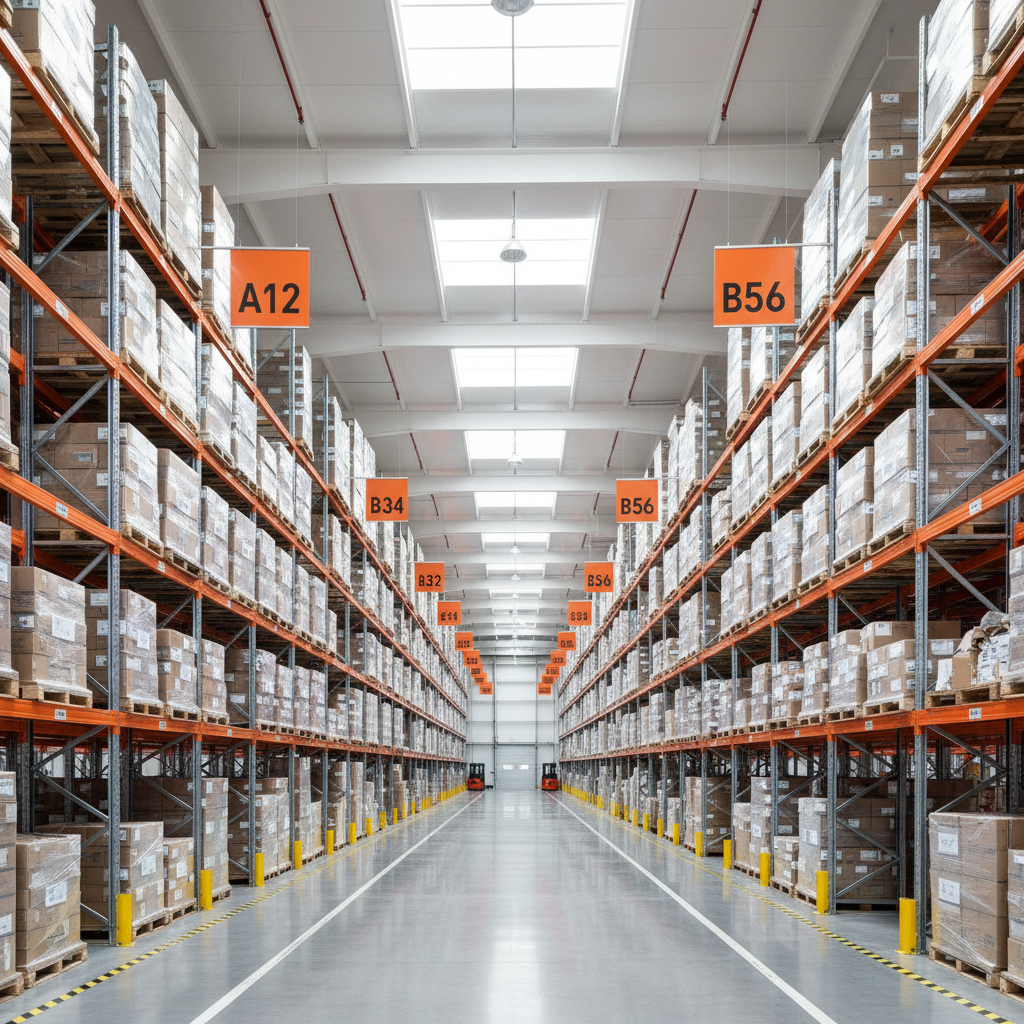
A core tenet of 5S methodology is visual management: creating an environment where any team member, regardless of their tenure, can understand workflow, direction, and location at a glance. In a busy distribution center, poor signage generates subtle searching waste that rarely shows up on standard operational reports. When aisle identifiers are too small, hidden by overhead ductwork, or inconsistently formatted across different storage bays, material handlers hesitate, second-guess their pick path, and occasionally pull from the wrong bay entirely.
Correcting an order mis-pick after it leaves the facility is dramatically more expensive than getting it right at the rack face. Clear visual cues remove cognitive fatigue from routine warehouse tasks. High-contrast hanging aisle signs (whether flat, 45-degree angled, or multi-sided cube designs suspended from roof trusses) allow operators to navigate broad aisles without checking handheld screens at every junction. Consistent visual numbering paired with color-coded shelf level indicators helps pickers confirm they are at the correct pick face before their hand ever touches product.
Building Resilient Operations Through Practical Floor Details
Taking costs out of your operation does not require sweeping software replacements or aggressive labor speed-ups. The most dependable, sustainable gains come from identifying and resolving the small mechanical snags that frustrate floor teams and eat away at productivity every day.
Whether your continuous improvement project calls for durable rack overlays to speed up seasonal re-slotting, ground-level scannable signage for high pallet bays, or impact-resistant floor protection for staging lanes, the right supplies make standard operating procedures stick.
When you want to evaluate your facility labeling strategy or request physical samples to test on your own racking, contact the CIS operations team to speak directly with an industrial packaging and warehouse specialist. Real people answering real calls means you get direct answers and domestic inventory delivered without hassle.
***
An Operations Fact to Consider: Studies in industrial ergonomics frequently note that the average warehouse order selector walks between six and ten miles during an eight-hour shift. Eliminating just fifty steps per pick cycle through better rack layout, clear visual signage, and dependable ground-level scanning can save an individual picker over a mile of unnecessary walking each day. Multiply that across your entire floor team, and the recovered capacity easily funds your next continuous improvement initiative.