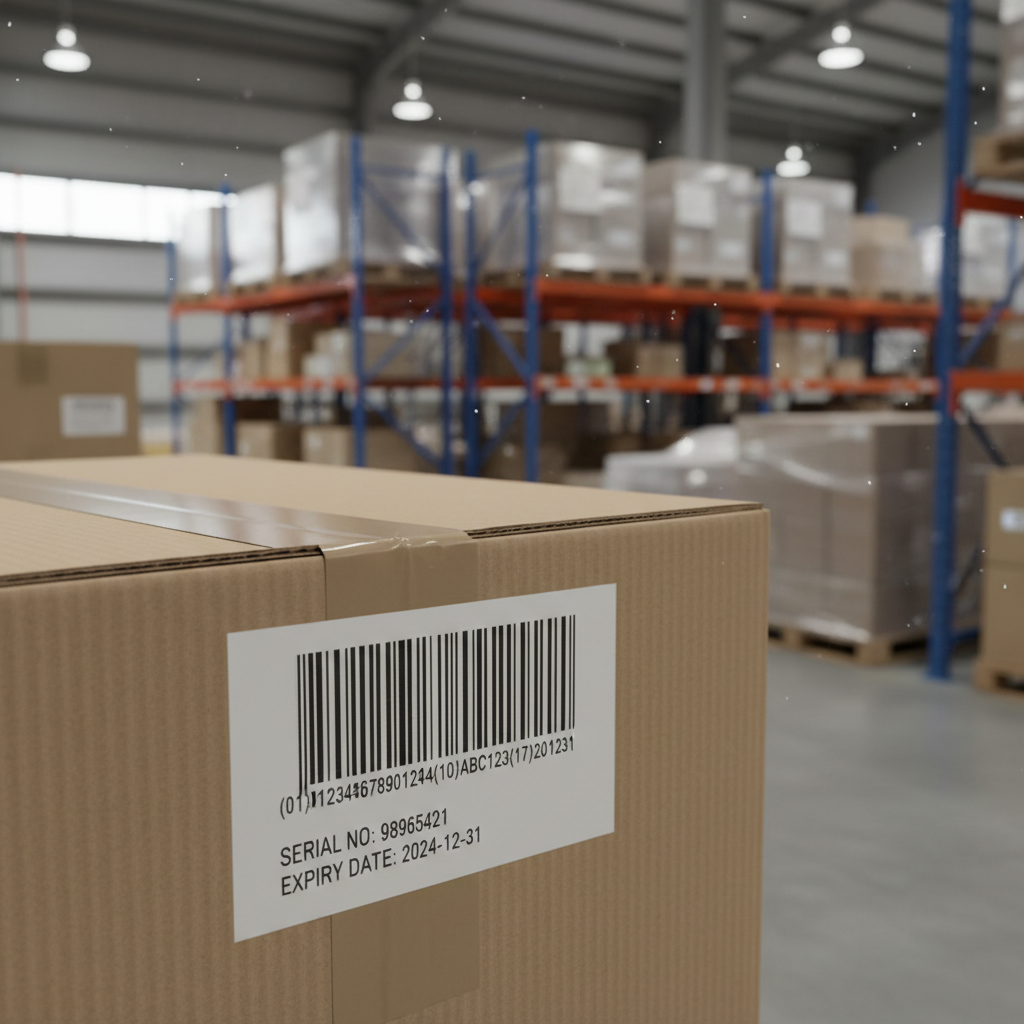
For consumer brands supplying big box retailers, the world of logistics often feels like navigating a maze of acronyms and precise requirements. Among these, GS1-128 barcodes stand out as a non-negotiable element. We frequently hear from retail operations managers, vendor compliance specialists, and shipping supervisors about the frustration and financial hit of chargebacks due to non-compliant labeling. It is a common pain point, and frankly, it is completely avoidable with a clear understanding of what big retailers are asking for.
You might look at a standard Code 128 barcode and a GS1-128 barcode side-by-side and not see a difference. They both use the same bar and space patterns, and a basic scanner might even decode both. However, this visual similarity hides a critical distinction that can cost your business a lot of money in rejected shipments and penalties.
What is the Difference: Code 128 vs. GS1-128?
Think of it this way: Code 128 is like the alphabet. It provides the characters and rules for forming words. GS1-128, on the other hand, is like a specific language built using that alphabet, with its own vocabulary and grammar rules.
Code 128 is a *symbology*. It defines how data (characters, numbers) gets translated into the physical bars and spaces that a scanner reads. It is a robust way to encode a lot of information in a compact space. However, it does not assign meaning to that information. If you print "123456789" using Code 128, a scanner just gives your software "123456789". The software then has to figure out what that string of numbers means.
GS1-128, formerly known as UCC-128 or EAN-128, is a *data standard* that uses the Code 128 symbology. It specifies exactly *what* information should be encoded and *how* it should be structured. This is achieved through "Application Identifiers" (AIs). These are two, three, or four-digit prefixes that tell the scanner and the receiving system what kind of data follows. For example:
* (01) identifies a Global Trade Item Number (GTIN)
* (10) identifies a Batch or Lot Number
* (15) identifies a Production Date
* (21) identifies a Serial Number
* (00) identifies a Serial Shipping Container Code (SSCC)
When a big box retailer specifies a GS1-128 label, they are not just asking for any Code 128 barcode. They are asking for a barcode that contains specific, standardized data fields, identified by AIs, in a particular format. This standardized data allows their automated receiving systems to instantly identify product, quantity, lot number, and importantly, the SSCC, which is crucial for tracking entire shipments.
Why Big Retailers Insist on GS1-128
The main reason big retailers demand GS1-128 compliance is efficiency and traceability throughout their supply chain.
- Automated Receiving: Imagine a large distribution center receiving thousands of pallets and cartons daily. Manual data entry is slow, prone to errors, and expensive. GS1-128 labels, especially those with SSCCs, allow for rapid, automated scanning of entire shipments. One scan of a carton with an SSCC barcode immediately links that physical box to its electronic manifest, confirming contents and destination.
- Inventory Accuracy: Standardized data means fewer discrepancies between what was shipped and what was received, leading to more accurate inventory counts and faster shelf replenishment.
- Traceability and Recall Management: In industries like food and beverage, pharmaceuticals, and even consumer goods, the ability to quickly trace products back to their origin in case of a recall or quality issue is paramount. GS1-128 with AIs for lot numbers, production dates, and serial numbers makes this possible.
- Vendor Compliance and Chargebacks: Retailers have strict vendor compliance programs. Non-compliant labels, even if they visually appear correct, can lead to rejected shipments, costly chargebacks, and damaged vendor relationships. These penalties are designed to recoup the costs associated with manual processing and delays caused by non-standardized labels.
Avoiding Chargebacks: Practical Steps
For retail operations, vendor compliance managers, and shipping supervisors, ensuring GS1-128 compliance means focusing on a few key areas:
* Understand Retailer Specifications: Each retailer will have specific GS1-128 label requirements. These documents detail which AIs are required, the placement of the barcode and human-readable data, and the overall label format. Do not guess; get the current specifications directly from your retail partners.
* Generate Correct Barcode Data: You need a system that can accurately generate the GS1-128 data string, including the correct AIs and checksums. Many ERP or warehouse management systems (WMS) have modules for this, or you might use specialized software.
* Use High-Quality Labels and Ribbons: The best data in the world is useless if the barcode cannot be scanned. High-quality labels ensure good print contrast and durability through the shipping process. Thermal transfer printing is generally preferred for GS1-128 labels because of its permanence. Choosing the right ribbon (wax, wax-resin, or resin) depends on the label material and environmental conditions.
* Invest in Reliable Printing Equipment: Industrial-grade thermal transfer printers are designed for the high volume and precision needed for compliance labeling. Regular maintenance and proper calibration are also critical.
* Verify Scannability: Before any shipment leaves your dock, scan a sample label with a barcode verifier, not just a scanner. A verifier measures print quality against industry standards, giving you an objective pass/fail grade and identifying potential issues before they become chargebacks.
Ensuring your GS1-128 labeling is compliant is not just about avoiding penalties. It is about contributing to a smoother, more efficient supply chain that benefits both your business and your retail partners.
If you are looking for reliable, high-quality industrial labels that meet the demands of big box retailer compliance, check out our selection of industrial labels. We stock a wide range of materials compatible with thermal transfer printing, ready to support your GS1-128 needs.
What is one unexpected labeling requirement you have encountered from a big box retailer?
Need barcode labels printed for you? See printed Amazon FNSKU and UPC label rolls.