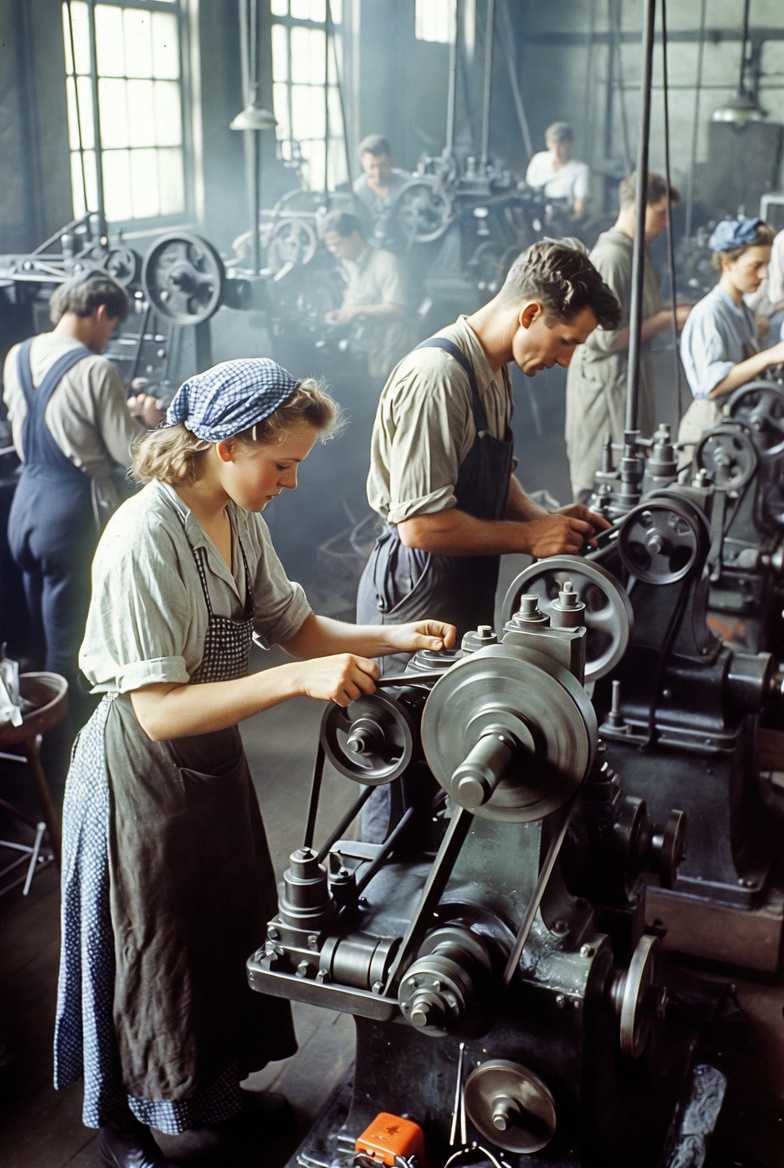
On June 6, 1944, the success of D-Day was made possible not just by courage on the beaches, but by an extraordinary industrial effort back home. As we mark the 82nd anniversary, the lessons from America's wartime manufacturing surge remain strikingly relevant for today's supply chain and manufacturing leaders.
Today marks the 82nd anniversary of D-Day, June 6, 1944, when Allied forces launched the largest amphibious invasion in history. While we rightly honor the bravery of the soldiers who stormed the beaches of Normandy, the success of that operation was also built on something equally powerful: American manufacturing at its peak.
In the years leading up to and during World War II, the United States transformed into what President Franklin D. Roosevelt called the "Arsenal of Democracy." Factories that once produced cars and refrigerators were rapidly converted to build ships, aircraft, tanks, ammunition, and countless other supplies at a scale the world had never seen. Between 1941 and 1945, American industry produced:
- Over 300,000 aircraft
- Nearly 100,000 tanks and armored vehicles
- More than 2,700 Liberty Ships
- Millions of tons of steel, aluminum, and other critical materials
This wasn't just about volume. It was about speed, adaptability, and innovation under extreme pressure.
What WWII Manufacturing Taught Us
Several lessons from that era remain highly relevant for manufacturers and supply chain professionals in 2026:
1. Scale and Speed Are Possible When the Mission Is ClearThe U.S. didn't gradually ramp up production, it mobilized at extraordinary speed. Today, as companies and governments push for reshoring and supply chain resilience, the question is no longer "Can we do it?" but "Do we have the clarity of purpose and coordination to do it at the speed required?"
2. Innovation Thrives Under ConstraintWartime manufacturing drove massive advances in production techniques, quality control, workforce training, and logistics. The same principle applies today as manufacturers adopt automation, AI, and advanced manufacturing technologies to overcome labor shortages and rising complexity.
3. Domestic Manufacturing Capacity Is a Strategic AssetThe war proved that having robust industrial capacity at home is not just an economic issue, it is a matter of national security and resilience. This lesson feels especially relevant now as companies and policymakers work to strengthen domestic supply chains and reduce critical dependencies.
4. People and Purpose Drive PerformanceThe iconic image of "Rosie the Riveter" reflected a real expansion of the workforce. When people understand the mission and feel their work matters, they rise to extraordinary levels of performance. In today's environment, this remains one of the most powerful competitive advantages in manufacturing.
Looking Forward
Eighty-two years later, the world looks very different. We no longer face the same existential threat, but we do face complex challenges: fragile global supply chains, rapid technological change, workforce shortages, and geopolitical uncertainty.
The manufacturers who will thrive in the decades ahead are those who can combine the urgency and ingenuity of the WWII era with the advanced tools and systems available today.
At Country Innovation & Supply, we believe the future belongs to organizations that treat manufacturing not just as a cost center, but as a strategic capability, one that requires continuous innovation, resilient supply chains, and a workforce that is skilled, engaged, and mission-driven.
On this anniversary of D-Day, we honor the generation that built the Arsenal of Democracy. And we challenge today's manufacturers to ask:
What would it look like for us to rise to a similar level of purpose and performance?